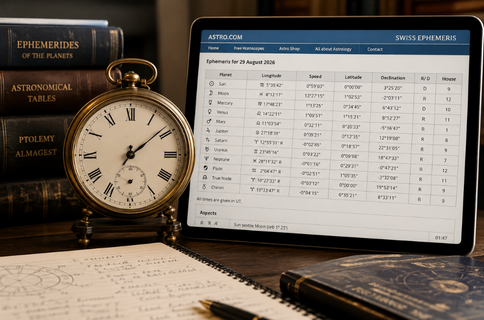
Astrology prediction is often misunderstood. We make predictions about the future every day without thinking of ourselves as fortune tellers.
At 9:00 in the morning, you might say that you’ll finish work at 5:30, meet friends for dinner at 7:00 and be home before midnight. None of those events has happened yet.
Nevertheless, you are reasonably comfortable describing them as part of your future.
You can do this because clocks and calendars allow you to locate yourself within patterns of time.
Astrologers do something surprisingly similar — except their clock has planets instead of hands.
A Clock on a Much Bigger Scale
There is an important distinction between predicting where a planet will be and predicting what its position might mean.
The first is primarily mathematics.
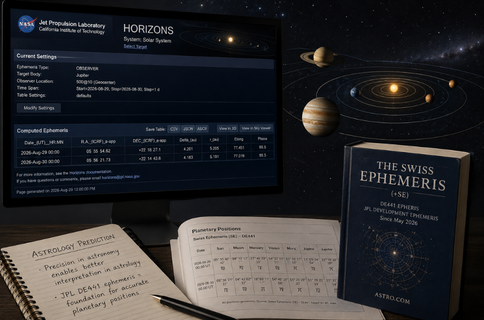
The movements of planets can be calculated with remarkable precision. NASA’s Jet Propulsion Laboratory produces planetary and lunar ephemerides originally developed to support spacecraft missions, while its Horizons system can generate positional information for solar system objects at specified times. Astrology has benefited enormously from this astronomical precision.
The Swiss Ephemeris, widely used by astrology software developers, is largely based on JPL data. Since May 2026, it has used JPL’s DE441 ephemeris.
“We know where the planets will be. Yet, we don’t know what Tuesday will bring.”
So an astrologer saying that Jupiter will occupy a particular position on a particular date isn’t really making a prediction in the way most people understand the word.
That position can be calculated.
The interesting question is what happens next.
Fact, Interpretation and Prediction
This is where three different things are often bundled together.
Suppose an astrologer knows that two planets will form an exact aspect next month.
The fact is the astronomical event. The planets will reach those calculated positions regardless of whether anyone attaches astrological significance to them.
The interpretation comes from astrology. The astrologer considers the planets involved, the nature of the aspect, previous experience, astrological tradition and the wider context in which the configuration occurs.
The astrology prediction comes when that interpretation is applied to what might happen next.
These are very different processes.
Technology is exceptionally good at the first. Modern software can calculate planetary positions, aspects, house cusps and countless other pieces of astrological data almost instantaneously.
It can also assist considerably with the second. Databases can retrieve previous configurations, software can identify patterns, and artificial intelligence can analyze large quantities of information and generate possible interpretations.
But moving from this configuration will occur to this is what will happen to you because of it is a much bigger leap.
We Are All Predictors
Perhaps part of astrology’s difficulty with the word “prediction” is that it conjures up images of someone claiming to know exactly what will happen.
Yet much of everyday life depends upon prediction.
Weather forecasts are predictions. Businesses forecast sales. Economists forecast growth. Navigation software predicts when we’ll arrive. Your calendar predicts where you intend to be next Thursday.
None of these systems requires absolute certainty to be useful.
They combine known information with patterns, assumptions and probabilities to tell us something useful about what may happen next.
Astrology prediction has its own version of this process.
An astrologer can know that Saturn will reach a particular point. What cannot be known with the same mathematical certainty is exactly how that symbolism will manifest in someone’s life.
That distinction matters enormously.
How Technology Changed Astrology Prediction
There was a time when simply establishing the positions of the planets required considerable work. Birth chart calculation before computers involved printed ephemerides, tables and calculations that modern software can now perform almost instantly.
Astrologers relied on printed ephemerides containing tables of planetary positions. Calculations had to be performed before interpretation could properly begin.
Today, an astrology application can do that work in moments. Astrodienst, for example, makes ephemerides available across thousands of years, while modern software can calculate positions automatically rather than requiring an astrologer to work through printed tables.
This is another example of technology changing astrology without necessarily replacing the astrologer.
The calculator became better.
The interpretive problem remained.
In fact, modern technology has made an interesting contradiction much clearer. We can calculate the astronomical ingredients of a future astrological event with extraordinary precision, yet the human consequences remain uncertain.
We know where the planets will be.
We don’t know exactly what Tuesday will bring.
Where AI Changes the Equation
Artificial intelligence adds another layer.
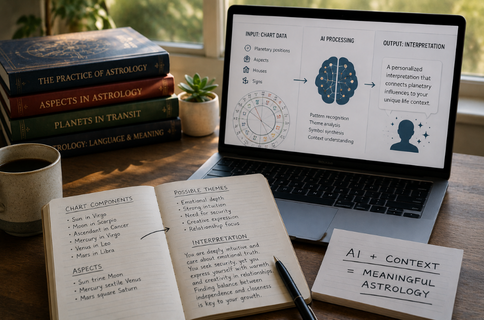
Traditional astrology software could calculate a chart and identify its components. Traditional astrology software could calculate a chart and identify its components. AI can now interpret birth chart data, working with language, context and enormous quantities of stored information.
So, the line between calculation and interpretation is blurring. AI can be given planetary positions and asked to interpret them. It can compare themes, summarize symbolism and generate personalized text faster than any human astrologer.
But speed is not certainty.
The fact that a computer can calculate a future Saturn aspect accurately does not mean it can state with equal accuracy what will happen when that aspect occurs.
Nor, for that matter, can a human astrologer.
The value lies in interpretation: identifying themes, possibilities, periods of pressure or opportunity, and helping someone understand how those might relate to the circumstances of their life.
Technology can contribute enormously to that process. But astronomical precision should never be confused with certainty about human events.
Perhaps “Prediction” Is the Wrong Word
This may be why some astrologers are uncomfortable describing their work as predicting the future at all.
Astrology prediction can be viewed instead as a way of examining timing.
A clock doesn’t make you leave the house at 8:15. It tells you that 8:15 has arrived. A calendar doesn’t force you to attend a meeting next Wednesday. It provides a framework within which that event has meaning.
An astrological chart can be considered another kind of clock — vastly more complicated, certainly, but nevertheless concerned with cycles and time.
Technology has given us an astonishing ability to read that clock. Computers can calculate its movements faster and more precisely than generations of astrologers working with printed tables could have imagined.
But knowing where the hands will point is only the beginning.
The real skill — whether performed by an astrologer, assisted by AI or increasingly undertaken by both — lies in deciding what that moment might mean.
Perhaps astrologers aren’t trying to see an unknowable future after all.
We already know where the hands of the celestial clock will point.
The difficult part has always been deciding what time it is telling us.
Thank you for reading.
Jeff Prince
Astrologer & Development Manager, Horoscope Services

About the author
Jeff Prince has spent more than 25 years helping to develop astrology software, horoscope APIs, white-label astrology platforms and globally syndicated horoscope content.
Through his Prinsights blog, he continues to explore the synergies between astrology, artificial intelligence and technology.