For most of astrology’s history, it wasn’t something that could reach into your pocket before breakfast.
Today, daily astrology can be almost impossible to avoid if you choose to engage with it. A horoscope can arrive by email, appear in an app, trigger a notification or sit permanently available on a website. You can check today’s planetary activity while waiting for the kettle to boil.
That feels completely normal now.
But it represents a remarkable change in our relationship with an ancient practice. Astrology hasn’t simply become easier to calculate or more personalized. Technology has changed how often we encounter it.
So when did astrology become something we check every day?
“We once went looking for astrology. Now astrology can come looking for us.”
When Astrology Had to Wait for the Newspaper
The modern habit has some surprisingly recent roots.
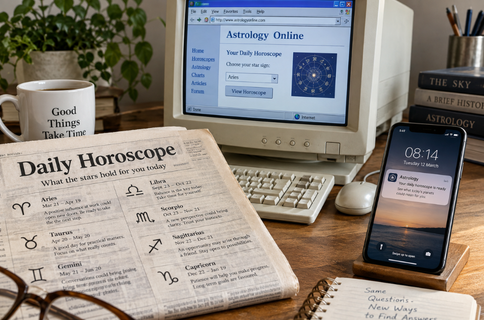
In 1930, Britain’s Sunday Express asked astrologer R. H. Naylor to produce a profile of the newborn Princess Margaret. The feature attracted enough attention for Naylor to be offered a regular column. By 1937, he was using the twelve Sun signs to address a much larger readership—the basic format that would become familiar globally.
The newspaper horoscope was an ingenious piece of mass communication. Instead of requiring an individual consultation and birth chart, astrology could speak to enormous numbers of people through twelve short forecasts.
But there was an important limitation.
The reader still had to go looking for the astrology.
You bought the newspaper, turned to the relevant page, found your sign and read your forecast.
Even if checking your horoscope became part of your daily routine, the newspaper controlled when the next installment appeared.
Technology would eventually remove that restriction.
Daily Astrology Moves Online
The internet didn’t invent daily astrology, but it transformed access to it.
By the late 1990s, horoscope publishing had established itself online. Astrodienst launched its website in 1996 and introduced free personal daily horoscopes on the site in August 1999. Other dedicated horoscope sites were also appearing during this period.
This was a more significant change than simply swapping paper for a computer screen.
A newspaper horoscope disappeared with yesterday’s newspaper. A website could be available 24 hours a day.
You no longer had to wait until tomorrow’s paper landed on the doormat. Astrology had acquired something it had never possessed on this scale before: permanent availability.
And the internet brought another major change. Websites could calculate individual charts, store information and offer forecasts based on more than a reader’s Sun sign.
As we explored in Personalized Horoscopes: How Technology Changed the Daily Forecast, digital technology made it possible to move from twelve forecasts for millions of readers toward astrology calculated for an individual.
But people still generally had to visit a website.
The next technological shift would reverse that relationship.
When Astrology Started Coming to Us
The smartphone changed many of our everyday habits because it combined constant internet access with something more powerful: notifications.
Astrology could now announce itself.
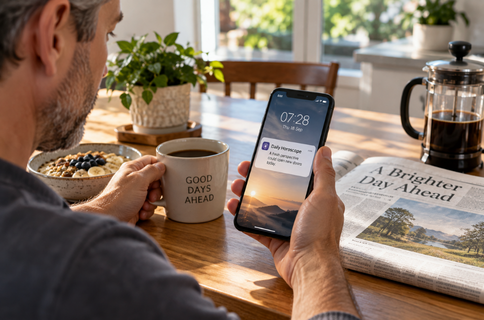
Modern astrology apps demonstrate just how far that idea has developed. Co–Star, for example, currently offers personalized daily horoscopes and daily push notifications based on the user’s horoscope. Other astrology apps provide transit alerts and personalized notifications connected with an individual’s chart.
That’s fundamentally different from opening a newspaper. For perhaps the first time, large numbers of people can have astrology actively tell them when there is something to read. The journey has therefore been extraordinary:
We once went looking for astrology. Now astrology can come looking for us.
Is More Astrology Necessarily Better?
This is where the story becomes more complicated.
Technology has solved a problem astrologers faced for centuries: access to astrological information required time, expertise and often money.
Today, an extraordinary amount of astrological information is available almost instantly.
Want to know today’s transits? Easy.
Want your birth chart? Seconds.
Want to know when a particular aspect becomes exact? Software can calculate it.
Want a daily interpretation based on your own chart? Increasingly, that’s available too.
As discussed in Birth Chart Calculation: When Doing the Math Was the Hard Part, computers have removed an enormous amount of manual calculation from astrology.
But removing scarcity creates another problem.
Abundance.
There can always be another transit to examine, another aspect to interpret, another notification to read and another forecast to check.
At some point, more information doesn’t necessarily produce more understanding.
Astrology Is About Time, Not Constant Attention
There is an interesting contradiction here.
Astrology is fundamentally concerned with cycles. Some unfold in hours or days; others develop over months or years.
Yet modern digital life encourages immediacy.
Refresh. Check. Scroll. Notify.
Daily astrology can easily become part of that same rhythm.
That doesn’t make daily horoscopes trivial. A good daily forecast can highlight a theme, provide perspective or encourage somebody to think differently about what’s happening in their life.
The danger comes when availability creates the impression that astrology must always have something urgent to tell us.
Not every planetary movement deserves equal attention.
A computer can identify thousands of pieces of astrological information. Deciding what is significant is a different task.
That’s one reason the role of the astrologer hasn’t disappeared simply because the calculations have become easier. As explored in AI Can Calculate Your Birth Chart. But Can It Be an Astrologer?, interpretation involves selection and judgment as well as information.
Sometimes expertise means knowing what not to emphasize.
From Scarcity to Abundance
There is something wonderfully ironic about all this.
For much of history, astrologers faced practical limitations in obtaining, calculating and distributing astrological information.
The printing press helped.
Newspapers helped enormously.
Computers accelerated calculation.
The internet removed geographical barriers.
Smartphones made astrology portable.
Notifications removed even the requirement to remember to check it.
Now AI adds another layer, potentially allowing people to question and explore astrological information conversationally.
Each technological development has reduced friction between a person and astrology.
But eventually we have to ask whether removing all the friction is desirable.
Perhaps We Don’t Need Astrology Every Minute
I’m not suggesting we return to waiting for tomorrow’s newspaper.
The accessibility of modern astrology is an enormous advantage. People who might never have visited a professional astrologer can now discover their birth chart, learn about planetary cycles and explore astrological ideas for themselves.
Technology has democratized access to information that was once much harder to obtain.
But there is a difference between making astrology available every day and believing we need it every day.
That may become one of the more interesting challenges facing modern astrology.
For decades, technology concentrated on giving us more information, more quickly and more personally. Perhaps the next stage should involve helping us distinguish the significant from the merely available.
Because the most useful astrology isn’t necessarily the astrology that shouts loudest, arrives fastest or sends the most notifications.
Sometimes its value comes from telling us something worth hearing at the right time.
And sometimes, perhaps, the most intelligent notification astrology could send us is no notification at all.
Thank you for reading.
Jeff Prince
Astrologer & Development Manager, Horoscope Services

About the author
Jeff Prince has spent more than 25 years helping to develop astrology software, horoscope APIs, white-label astrology platforms and globally syndicated horoscope content.
Through his Prinsights blog, he continues to explore the synergies between astrology, artificial intelligence and technology.
Enjoy Prinsights? Add Horoscope Services as a Preferred Source on Google.