Modern astrology has a remarkable precision problem.
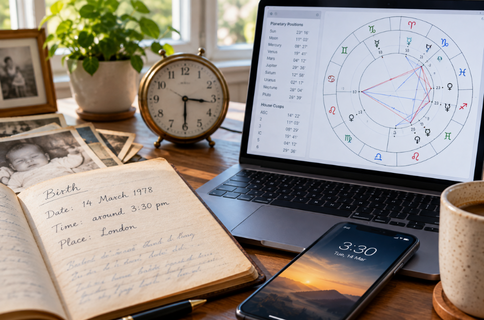
We can calculate a birth chart in seconds. Software can account for birthplace, time zone and daylight saving time automatically. Planetary positions can be calculated to fractions of a degree, and a chart that once required considerable manual work can appear on a phone almost instantly.
Yet all that precision can still begin with somebody saying:
“My mother thinks I was born at about half past three.”
Your accurate birth time has always mattered in astrology. But technology has created an interesting contradiction: our calculations have become extraordinarily precise while the information we feed into them may be anything but.
Why Does an Accurate Birth Time Matter?
A birth chart describes the sky for a particular place and moment. Change that moment and some parts of the chart change much more quickly than others.
Your birth date alone can establish a great deal. The slower-moving planets will barely shift during the course of a day. The Sun moves relatively slowly too.
However, the Ascendant is another matter.
According to Astrodienst, the Ascendant moves by an average of approximately one degree every four minutes, and even a 15-minute difference in birth time can affect an interpretation. Birth time and birthplace also determine the houses in a horoscope.
This means somebody born at 3:42 p.m. and somebody born in exactly the same place at 4:02 p.m. may have very similar planetary positions, but their chart angles and house cusps will not be identical.
If an accurate birth time is close to a change of rising sign, an apparently small error could potentially produce a different Ascendant altogether.
That’s not a failure of technology. The computer has calculated exactly what it was asked to calculate.
The problem is what we asked it to calculate.
A Perfect Calculation of Imperfect Information
This is not unique to astrology. Enter the wrong details into a satnav and you’re guaranteed to end up somewhere you didn’t plan to go. Astrology software faces the same fundamental limitation. Give it the correct data and it can perform calculations that would once have demanded considerable expertise and effort. As I explored in my article about birth chart calculation, computers have largely separated the labor of astronomical calculation from the work of astrological interpretation.
But software cannot know whether 6:15 a.m. really means 6:15 a.m.
Perhaps a parent remembers “around six.” Perhaps somebody wrote the time down incorrectly. Perhaps a remembered time has gradually acquired an undeserved air of certainty after being repeated for 40 years.
Technology can validate a time zone. It cannot interrogate your mother.
What If You Don’t Know Your Birth Time?
This is where good technology should acknowledge uncertainty rather than disguise it.
Astrodienst allows users to specify that their birth time is unknown. In that situation, it uses a hypothetical noon time and does not calculate houses. Its guidance also recommends trying to obtain the registered birth time where records are available.
That’s an important distinction.
An unknown or approximate birth time does not necessarily make an entire birth chart useless. Many planetary positions can still be established with considerable confidence from the date. The Moon needs more caution because it moves much faster and can change signs during a calendar day.
But without an accurate birth time, the Ascendant and houses become uncertain.
The responsible response isn’t to make the computer fill in the blanks and then pretend those blanks never existed. It’s to distinguish between what the available data supports and what it doesn’t.
Ironically, increasingly sophisticated astrology technology makes that honesty more important, not less.
“Technology can calculate a birth chart with extraordinary precision, but it cannot make uncertain birth information accurate.”
Can an Astrologer Work Out the Correct Time?
Astrologers have long used a process called birth time rectification when a birth time is unknown or uncertain.
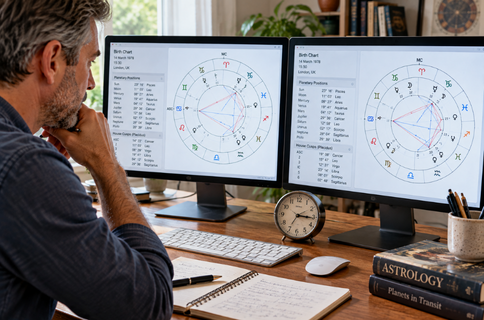
Broadly speaking, rectification involves working backward, comparing possible birth times with known events and other information from a person’s life. It sounds ideal: if the original information is missing, reconstruct it.
But rectification shouldn’t be confused with retrieving a forgotten password. There isn’t necessarily one universally accepted procedure capable of producing a demonstrably correct answer. Astrodienst says it does not offer rectification because it does not know of a method it considers sufficiently reliable.
That doesn’t mean astrologers cannot use rectification techniques. It means the resulting time should not automatically be treated as equivalent to a documented accurate birth time.
There is a broader lesson here for modern astrology: precision displayed on a screen is not necessarily certainty.
Technology Has Changed Our Expectations
A hand-drawn horoscope naturally looked like something created through interpretation and calculation.
A modern digital chart looks definitive.
The lines are exact. The degrees are exact. The house cusps are exact. Software can display numbers to impressive levels of precision.
That visual precision can encourage us to forget the uncertainty that may exist underneath it.
And AI introduces another dimension.
Give an AI system a calculated chart and it can discuss the Ascendant, houses and aspects as though every piece of information is equally secure – unless the system is also told that the underlying birth time is uncertain.
This is why the distinction between calculation and interpretation remains important. Technology can process the information it receives extraordinarily well. It still needs reliable information to begin with.
Better Technology Should Show Us What It Doesn’t Know
Perhaps the future of astrology software isn’t simply about producing increasingly detailed interpretations.
It may also involve communicating confidence more intelligently.
If somebody enters “approximately 9:00 a.m.,” why should a system necessarily behave as though 9:00:00 is established fact?
A smarter astrology service could distinguish between a documented accurate birth time, an approximate time and a completely unknown one. It could explain which parts of a chart remain stable across the possible time range and flag those that could change.
Instead of creating false precision, technology could make uncertainty visible.
That would be genuine progress.
We’ve spent decades making astrology calculations faster, easier and more precise. Now AI and increasingly sophisticated software are making interpretation faster too.
But there is still one thing no algorithm can manufacture after the fact: better original information.
The future of digital astrology won’t depend only on how accurately our technology calculates a chart. It will also depend on how honestly we tell that technology what we actually know.
Thank you for reading.
Jeff Prince
Astrologer & Development Manager, Horoscope Services

About the author
Jeff Prince has spent more than 25 years helping to develop astrology software, horoscope APIs, white-label astrology platforms and globally syndicated horoscope content.
Through his Prinsights blog, he continues to explore the synergies between astrology, artificial intelligence and technology.
Enjoy Prinsights? Add Horoscope Services as a Preferred Source on Google.