By Jeff Prince | Prinsights
Who invented astrology? It’s a question that takes us back thousands of years, to a time when somebody looked up at the night sky and decided the planets had something to say about what was happening down here on Earth.
It was an extraordinary leap of imagination.
Today, we can calculate planetary positions centuries into the future, photograph distant galaxies and send spacecraft billions of miles into space. Yet millions of people still consult a practice whose origins stretch back to civilizations that didn’t even have telescopes.
So, was there one particularly imaginative individual who started the whole thing? And why did anyone believe the heavens could reveal anything about human affairs?
The answers are rather more interesting than you might expect.
Astrology Didn’t Have One Inventor
If you’re hoping for the name of someone who woke up one morning and announced, “I’ve invented astrology!”, you’re going to be disappointed.
Nobody knows who invented astrology because it developed gradually, across generations and civilizations.
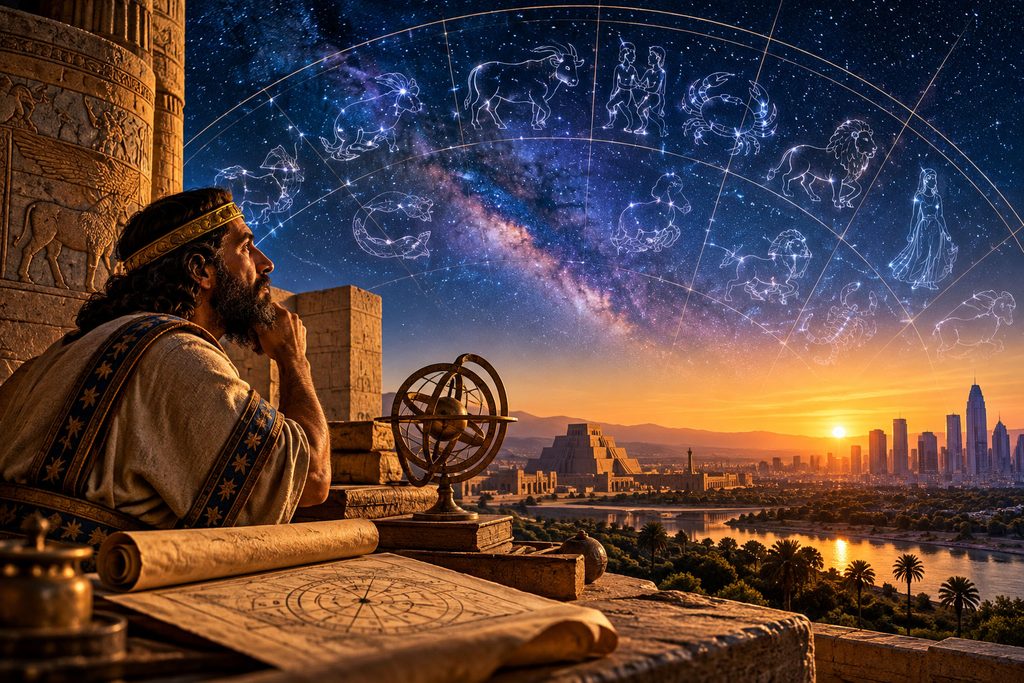
Its earliest identifiable roots lie in ancient Mesopotamia, particularly Babylonia, in the region that includes modern-day Iraq.
Long before newspapers carried daily horoscopes, Mesopotamian observers recorded the movements of the Sun, Moon, planets and stars. They noticed patterns, tracked eclipses and developed sophisticated methods of predicting celestial events.
But they weren’t simply studying the sky because it looked pretty.
They believed unusual events in the heavens could be signs concerning events on Earth.
A lunar eclipse, for example, might be interpreted as a warning involving a king or kingdom. Certain planetary appearances could be associated with political upheaval, prosperity or danger.
This early form of astrology wasn’t particularly interested in whether a Taurus would meet someone attractive at the weekend.
It was concerned with rather more pressing questions.
Would the king survive? Would the harvest succeed? Was war approaching?
And, perhaps most importantly, could something be done to prevent disaster?
“Astrology began not simply because ancient people wanted to know the future, but because they wanted to make sense of a world that could be frighteningly unpredictable.”
The Sky Was the Ancient World’s Warning System
Imagine living thousands of years ago.
There are no weather satellites, scientific instruments or news alerts. Disease can devastate communities, crops can fail without warning, and a ruler’s decisions can determine whether thousands of people live or die.
Now imagine looking up and seeing the Moon suddenly turn dark during an eclipse.
You know nothing about the mechanics of Earth’s shadow crossing the lunar surface.
Would you dismiss the event as meaningless?
Probably not.
Ancient civilizations often viewed the natural world as a place where divine powers communicated through signs. Unusual animal behavior, storms, dreams and celestial events could all carry significance.
The sky offered something particularly compelling: patterns.
The Sun followed a recognizable annual cycle. The Moon changed appearance in a predictable sequence. Certain stars returned to familiar positions with the seasons.
Even the planets, whose movements initially seemed rather erratic, eventually revealed mathematical regularities.
For people who believed the universe was connected through divine order, it wasn’t unreasonable within their worldview to wonder whether those patterns corresponded with events on Earth.
That doesn’t establish that astrology’s predictions were accurate.
But it helps explain why the idea emerged.
Astrology began not simply because ancient people wanted to know the future, but because they wanted to make sense of a world that could be frighteningly unpredictable.
From Kings and Kingdoms to Ordinary People
Here’s where astrology’s history takes a fascinating turn.
The earliest Mesopotamian celestial omens were largely concerned with rulers, states and public affairs.
Personal astrology developed much later.
By the late fifth century BCE, Babylonian astrologers were producing some of the earliest surviving individual horoscopes, using the positions of celestial bodies around a person’s birth.
This represented an enormous change.
The heavens were no longer being consulted exclusively about the fate of kingdoms. They were increasingly being connected with individual lives.
Over the following centuries, astrology developed further through exchanges between Babylonian, Egyptian and Greek traditions.
During the Hellenistic period, astrologers developed and systematized many techniques associated with Western natal astrology, including the interpretation of zodiac signs, planetary relationships and astrological houses.
The result was something considerably closer to the birth chart a professional astrologer might examine today.
And here’s an important distinction.
Ancient astrology wasn’t simply a collection of vague predictions invented by people who couldn’t do mathematics.
Some of its practitioners were accomplished astronomical observers and calculators.
They could predict celestial events with impressive precision using mathematical methods developed over generations.
Whether planetary positions could reveal someone’s personality or future was an entirely different question.
But the calculations themselves were serious work.
Why Did Intelligent People Believe in Astrology?
It’s tempting to assume that astrology survived because ancient people were gullible.
That explanation is convenient. It’s also historically rather shallow.
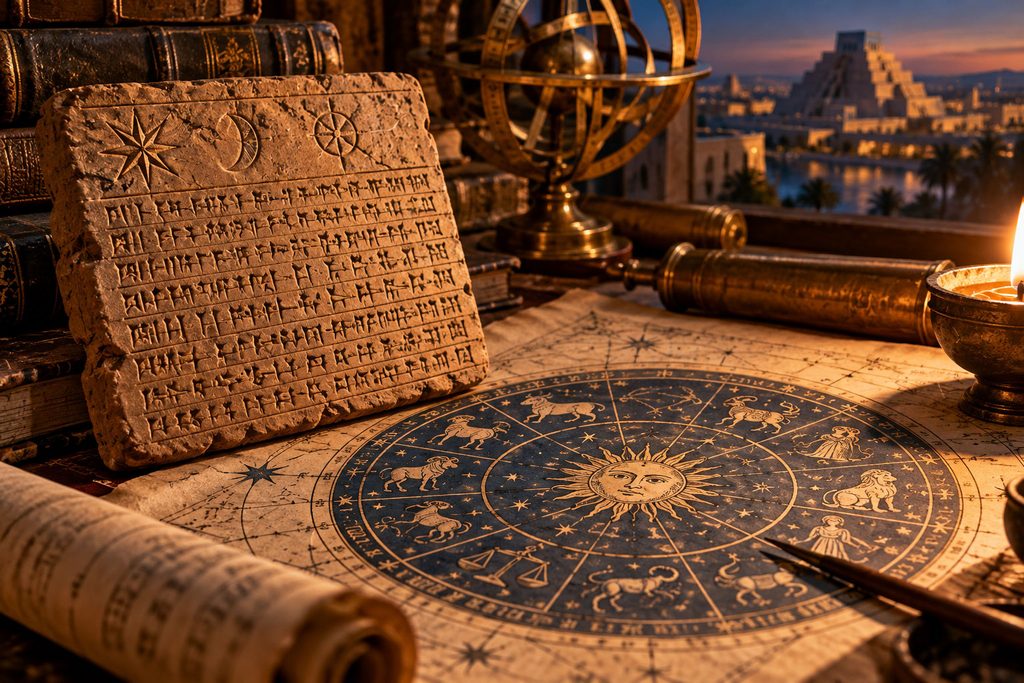
Asking who invented astrology is therefore only part of the story. Understanding why intelligent people accepted its principles for centuries is arguably the more fascinating question.
For much of human history, astrology existed within intellectual and religious frameworks that differed profoundly from modern scientific thinking.
The distinction between astronomy and astrology wasn’t always as clear as it is today.
People who studied celestial movements could also interpret their supposed significance.
Astrology attracted the attention of scholars, physicians, philosophers and political leaders. It was debated, criticized, defended and incorporated into different systems of thought.
Some accepted its principles. Others questioned whether the planets could genuinely influence human affairs or whether astrologers were claiming knowledge they didn’t possess.
Skepticism, in other words, isn’t a modern invention.
And belief in astrology wasn’t necessarily a sign that someone lacked intelligence.
It often reflected the accepted assumptions, available evidence and intellectual traditions of their time.
Of course, that doesn’t mean those assumptions were correct.
A sophisticated explanation can still be mistaken.
But understanding why people believed something is different from simply declaring them foolish for believing it.
Then Along Came the Greeks
Although astrology’s roots reach deep into Mesopotamian history, Greek-speaking scholars played an important role in shaping the Western tradition.
They developed and organized astrological ideas within broader philosophical and mathematical systems.
The zodiac became central to the interpretation of planetary positions, while increasingly elaborate methods attempted to connect celestial configurations with individual characteristics and events.
One particularly influential figure was Claudius Ptolemy.
Writing in the second century CE, Ptolemy produced the Tetrabiblos, an influential work that sought to explain astrology through the natural philosophy of his era.
He wasn’t astrology’s inventor, and his approach wasn’t universally accepted.
But his work helped establish an intellectual framework that influenced astrological thinking for centuries.
It’s worth remembering that the same Ptolemy also made major contributions to mathematical astronomy and geography.
History rarely divides people into the neat categories we’d prefer.
When Did Astrology Become Twelve Daily Horoscopes?
Now for the part I find particularly amusing.
After thousands of years of celestial observations, mathematical calculations, philosophical arguments and elaborate birth-chart interpretations, astrology eventually became something you could read beside the crossword.
How did that happen?
The familiar newspaper horoscope is a remarkably recent development compared with astrology’s long history.
One famous milestone occurred in 1930, when Britain’s Sunday Express published an astrological feature about the newborn Princess Margaret, written by astrologer R. H. Naylor.
Naylor’s subsequent newspaper work helped popularize astrology for a mass readership.
By the middle of the twentieth century, Sun-sign horoscope columns had become increasingly familiar features of newspapers and magazines.
Suddenly, people didn’t need to know their exact birth time or consult an astrologer.
They simply needed to know whether they were an Aries, Taurus, Gemini or one of the other nine zodiac signs.
A complicated tradition had been compressed into twelve convenient categories.
From a publishing perspective, it was brilliant.
From an astrological perspective, it was an extraordinary simplification.
And it helps explain why so many people today assume astrology consists entirely of a few sentences predicting romance, money or an unexpected telephone call.
Does Astrology’s Long History Make It True?
Here’s a question that deserves a straightforward answer.
No. Astrology’s age doesn’t establish its accuracy.
The fact that people have practiced something for thousands of years doesn’t mean its claims are scientifically valid.
Modern scientific research hasn’t established astrology as a reliable method for predicting personality traits or future events.
Historical importance and scientific validity are two separate matters.
Nevertheless, dismissing astrology as nothing more than newspaper nonsense overlooks an extraordinary story involving ancient civilizations, astronomy, mathematics, religion, philosophy and the human desire to understand uncertainty.
And whether someone believes in astrology or not, that history is worth exploring.
Perhaps the Most Interesting Question Isn’t Who Invented Astrology
We began by asking who invented astrology.
The answer is that no single person did.
It evolved as people watched the heavens, recognized patterns and attempted to understand whether those patterns meant something for life on Earth.
Over centuries, the practice changed from interpreting omens concerning kings and kingdoms to examining individual birth charts.
Eventually, it found its way into newspapers, magazines, websites and mobile phones.
Quite a journey for an idea that began beneath the ancient night sky.
But perhaps the most interesting question isn’t who invented astrology.
It’s why the idea has proved so difficult to abandon.
We now understand eclipses, planetary orbits and the physical forces governing the Solar System in ways ancient astrologers could scarcely have imagined.
Yet we still wonder what tomorrow might bring, whether our decisions will work out and whether our lives follow patterns we haven’t recognized.
Science can explain how the planets move.
Astrology offers interpretations of what those movements might mean, although those interpretations remain scientifically unproven.
And perhaps that’s why astrology continues to fascinate people thousands of years after its beginnings.
The sky hasn’t stopped inspiring questions. We’ve simply become much better at calculating what’s happening up there.
Thank you for reading.

Jeff Prince
Astrologer & Development Manager, Horoscope Services

About the author
Jeff Prince has spent more than 25 years helping to develop astrology software, horoscope APIs, white-label astrology platforms and globally syndicated horoscope content.
Through his Prinsights blog, he continues to explore the synergies between astrology, artificial intelligence and technology.
Enjoy Prinsights? Add Horoscope Services as a Preferred Source on Google.