When my youngest son was due to be born, we were repeatedly given April 8 or 9 as his expected arrival date.
April 8 came and went. So did April 9. By April 19, he still hadn’t made an appearance, and the decision was made to induce labor.
As an astrologer, I found myself wondering about something rather unusual. If medical intervention could determine when my son entered the world, wouldn’t it also determine his horoscope?
I contacted the late British astrologer Jonathan Cainer and put the question to him.
Jonathan explained that an induced birth was no different astrologically from a spontaneous one. The birth time in astrology, in other words, the important moment, he said, was when the baby entered the world and took its first breath.
His answer made sense within the traditional framework of natal astrology. But it also raises a question that deserves closer examination.
When comparing a birth chart vs conception chart, why should the moment we arrive in the world matter more than the moment our existence began?
Birth Chart vs Conception Chart: Why Does Astrology Favor Birth?
A birth chart is calculated using the date, time, and geographical location of someone’s birth. It shows the positions of the Sun, Moon, and planets, along with the Ascendant and other important points in the horoscope.
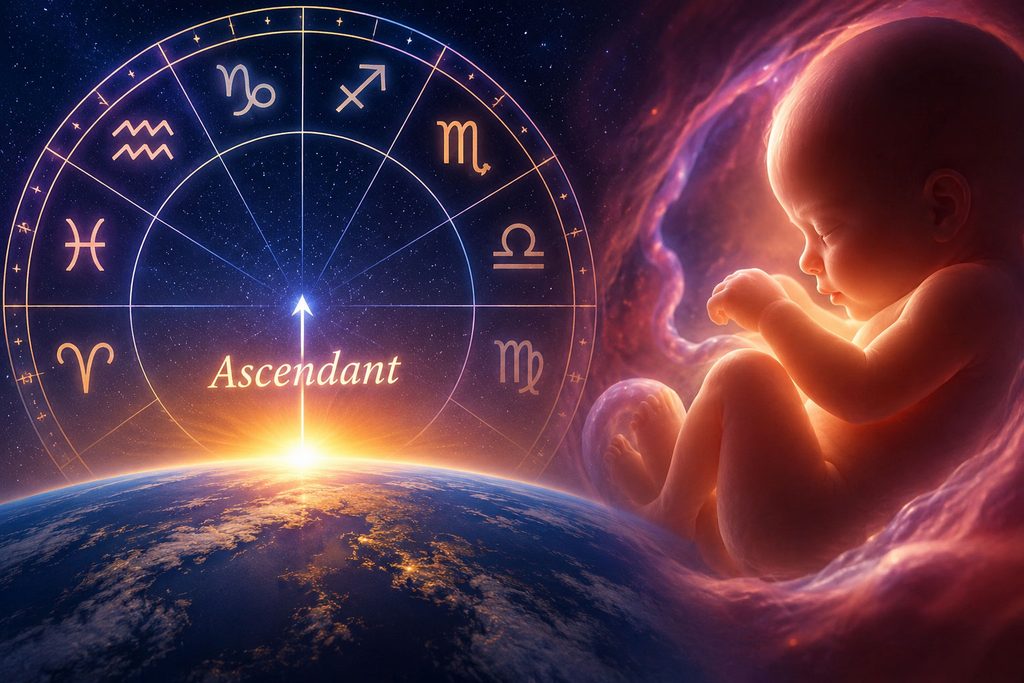
The Ascendant, or rising sign, is particularly sensitive to timing. Because Earth rotates, the zodiac sign rising on the eastern horizon changes approximately every two hours, although the exact rate varies.
A difference of even a few minutes can alter the degree of the Ascendant and the boundaries of the astrological houses.
This is why astrologers place considerable importance on accurate birth times.
But why birth? After all, by the time a baby arrives, an extraordinary amount of development has already taken place. Organs have formed, the nervous system has developed, and the baby has spent months responding to conditions inside the womb.
If astrology is concerned with the circumstances surrounding the beginning of a human life, conception seems an equally reasonable starting point.
Interestingly, some ancient astrologers thought so too.
“Birth may be easier to pinpoint than conception. But does that make it more astrologically significant?”
What Did Ancient Astrologers Think About Conception?
The Greek astronomer and astrologer Claudius Ptolemy, writing in the second century CE, addressed this very question in his influential work, Tetrabiblos.
Ptolemy distinguished between conception and birth as two beginnings of human existence.
He regarded conception as the natural starting point of generation. He also acknowledged that determining its precise timing was usually impossible.
Consequently, he recommended using the moment of birth when conception could not be established.
In other words, the preference for birth wasn’t necessarily based on a belief that conception was astrologically irrelevant.
Ptolemy also attributed significance to birth itself, regarding it as the beginning of a new state of existence. He argued that the celestial configuration at birth could symbolize the individual’s subsequent life.
His reasoning is preserved in the University of Chicago’s edition of Tetrabiblos.
Of course, Ptolemy’s ideas belong to the history of astrology, not to modern scientific knowledge about human development.
Nevertheless, they reveal something important: the debate about conception versus birth is almost as old as the surviving literature of natal astrology itself.
Why Is the Exact Moment of Conception So Difficult to Establish?
Conception presents a practical problem that even modern medicine cannot always solve.
People sometimes assume that conception occurs at the moment of sexual intercourse. Biologically, however, intercourse and fertilization are separate events.
Sperm may survive in the female reproductive tract for several days, while an egg remains capable of fertilization for a relatively short period after ovulation.
Fertilization may therefore occur hours or even days after intercourse.
There is also a distinction between fertilization, when sperm and egg unite, and implantation, when the developing embryo attaches to the uterine lining.
Which event should an astrologer use?
Modern medicine can estimate gestational age with considerable accuracy, particularly through early ultrasound examinations. But an estimated due date is not a timestamp for fertilization.
The American College of Obstetricians and Gynecologists’ guidance on estimating due dates explains the methods and limitations involved.
Assisted reproductive techniques, including IVF, can provide much more precise information about the timing of fertilization and embryo development.
Even then, identifying one definitive instant for astrological purposes involves a choice about what constitutes the relevant beginning.
Birth, by comparison, is a much more observable event.
That makes it convenient. But convenience alone doesn’t establish astrological significance.
Does the First Breath Really Begin a Horoscope?
Jonathan Cainer’s explanation to me reflected a familiar astrological interpretation: birth marks the moment a child begins an independent existence outside the womb.
The first breath is a powerful symbol of that transition. That determines the birth time in astrology.
Before birth, the developing baby receives oxygen through the placenta. After birth, the lungs begin performing the essential task of exchanging oxygen and carbon dioxide.

It’s a remarkable physiological change.
In symbolic terms, the first breath can represent an individual’s entrance into the wider world.
But there’s a complication.
A baby doesn’t necessarily take its first breath at precisely the moment recorded as its birth time. Some newborns require assistance before breathing effectively.
Furthermore, birth itself is a process rather than a single instantaneous event.
Should an astrologer use the moment the baby’s head emerges? The moment the entire body is delivered? The first breath? The cutting of the umbilical cord?
Different traditional interpretations have emphasized different moments.
In contemporary practice, astrologers generally work with the recorded time of birth.
That is a practical convention, although it doesn’t always correspond exactly to the first breath.
Can Induced Labor or a Caesarean Change Someone’s Horoscope?
This brings us back to my son’s arrival.
Had labor begun naturally on April 8 or 9, his horoscope would have reflected the planetary positions at that time.
Instead, he arrived after medical intervention on April 19.
His actual birth chart was therefore different from any hypothetical chart calculated for his original due date.
There is no getting around that astronomical fact.
The question is what it means astrologically.
One traditional interpretation holds that the circumstances leading to birth, including medical decisions, are simply part of the events surrounding an individual’s arrival.
Under this view, the actual birth moment is what matters, regardless of whether labor began spontaneously or was induced. That certainly makes the birth time in astrology easier to determine.
Another interpretation might regard the timing of birth as an expression of a wider pattern, incorporating the decisions of parents, doctors, and medical circumstances.
However, neither interpretation provides scientific evidence that the resulting planetary positions determine a person’s character or future.
And consider scheduled Caesarean deliveries.
If parents and doctors can choose a delivery date within medically appropriate limits, they can also influence the planetary positions appearing in the child’s birth chart.
They may even influence the Ascendant by selecting a particular time.
Does this mean a horoscope can be designed?
Astrologically, it raises a fascinating philosophical problem. Medically, however, decisions about delivery must always prioritize the health of the mother and baby, not the desirability of a particular chart.
Could a Conception Chart Tell Us Something Different?
Some astrological traditions have attempted to calculate charts for conception, sometimes using retrospective techniques to estimate when conception occurred.
One historically associated method is the Trutine of Hermes, which seeks relationships between the Moon’s position and the Ascendant at conception and birth.
Such techniques are part of astrology’s historical development, but their accuracy has not been scientifically demonstrated.
A conception chart and a birth chart would also represent substantially different celestial arrangements.
The Sun could occupy a different zodiac sign. The Moon would almost certainly be elsewhere. Faster-moving planets might have changed signs, while the Ascendant would depend on the assumed conception time and location.
This leads to another intriguing question.
Would a conception chart describe the individual’s biological development, while a birth chart symbolically describes their life in the outside world?
That distinction might appeal to astrologers who view charts as symbolic representations rather than direct physical causes.
But it remains an interpretation, not an established fact.
What Does Science Say About Birth Charts and Conception Charts?
Science has established that conditions before birth can influence human development.
Genetics, maternal health, nutrition, environmental exposures, and numerous other biological factors play important roles.
That doesn’t mean the positions of planets at conception or birth have been shown to determine personality, relationships, or future events.
Reliable scientific evidence supporting those astrological claims is lacking.
This distinction matters.
An astrologer may find symbolic value in the moment of birth without claiming that planetary positions physically shape a newborn’s destiny.
Likewise, someone may question the astrological significance of birth without dismissing the historical and cultural importance of astrology.
As we explored in our previous article on medical astrology and the history of medicine, beliefs can exert considerable cultural influence without being scientifically established.
The same critical distinction applies here.
So Why Does Astrology Begin at Birth?
The birth chart vs conception chart debate doesn’t have a single answer accepted by every astrological tradition.
Birth offers an identifiable event, a practical starting point for calculation, and a powerful symbol of entering the world as an individual.
Conception offers a different kind of beginning, one that some ancient astrologers considered astrologically meaningful but exceptionally difficult to time.
My conversation with Jonathan Cainer has stayed with me because it captured the traditional position so neatly: whatever brings a baby into the world, the actual moment of arrival is the moment used to cast the horoscope.
But I think Ptolemy’s much older argument makes the subject even more interesting.
Nearly two thousand years ago, astrologers were already wrestling with the distinction between when a life begins developing and when that life enters the world.
Perhaps the most revealing question isn’t simply whether a birth chart or conception chart is preferable.
It’s whether astrology’s choice of a starting point reflects something intrinsic to human existence—or the very human need to give an extraordinary event a precise moment on the clock.
Thank you for reading.

Jeff Prince
Astrologer & Development Manager, Horoscope Services

About the author
Jeff Prince has spent more than 25 years helping to develop astrology software, horoscope APIs, white-label astrology platforms and globally syndicated horoscope content.
Through his Prinsights blog, he continues to explore the synergies between astrology, artificial intelligence and technology.
Enjoy Prinsights? Add Horoscope Services as a Preferred Source on Google.