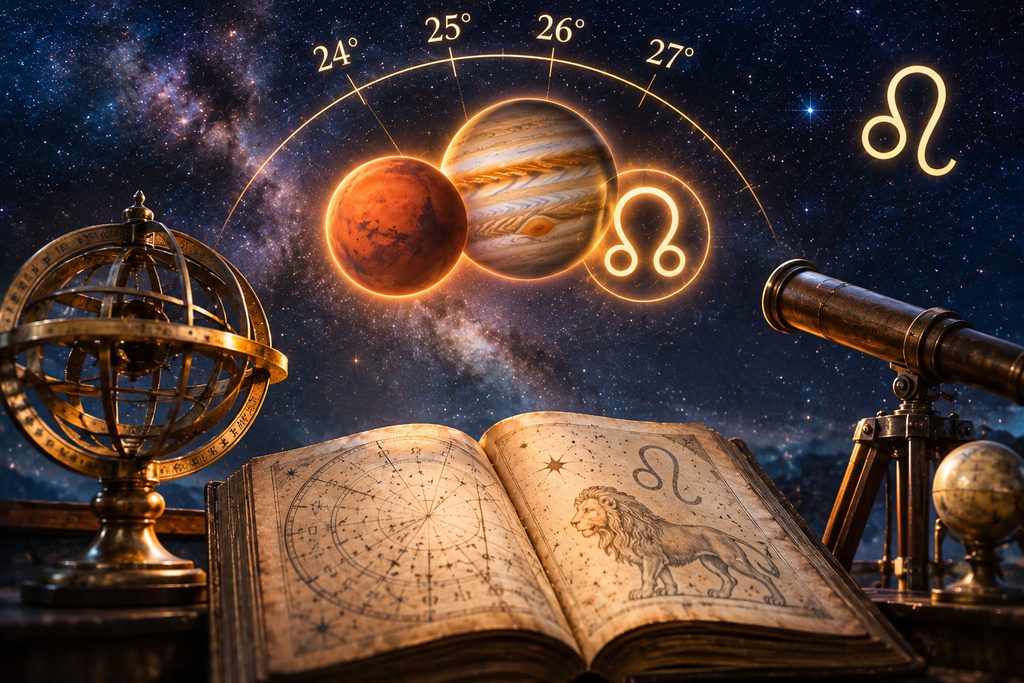
Something unusual is happening in the zodiac this November. Mars, Jupiter and the South Node are gathering around the same degree of Leo, creating a planetary alignment that has attracted considerable attention among astrologers.
The Mars, Jupiter and South Node conjunction of November 2026 brings together three very different astrological symbols: ambition, expansion and the patterns we carry from the past.
Some astrologers see an opportunity for breakthroughs. Others warn about overconfidence, impulsive decisions and repeating mistakes with renewed enthusiasm.
So what is actually happening in the sky? Why is this particular combination attracting attention? And does a rare alignment necessarily mean something extraordinary is about to happen?
When Do Mars, Jupiter and the South Node Align in November 2026?
The action unfolds over several days, with all three conjunctions occurring around 25 degrees of Leo.
Using the true lunar node and UK time, the key dates are:
- November 12: Jupiter conjunct the South Node.
- November 14: Mars conjunct the South Node.
- November 16: Mars conjunct Jupiter.
A conjunction occurs when two astrological factors occupy the same degree of zodiacal longitude, as viewed from Earth.
That doesn’t mean the planets are physically close together in space. Mars and Jupiter remain separated by enormous distances. They simply appear in approximately the same direction along the zodiac.
And there’s another important distinction.
The South Node isn’t a planet, asteroid or mysterious object lurking somewhere beyond Neptune.
It’s a mathematical point.
The Moon’s orbit is tilted relative to the plane of Earth’s orbit around the Sun, known as the ecliptic. The two points where these orbital planes intersect are called the lunar nodes.
As NASA’s explanation of orbital nodes makes clear, these are geometrical intersections, not physical bodies.
Astronomically, the arrangement is entirely calculable. Its significance, however, belongs to the interpretive traditions of astrology.
And that’s where things become interesting.
What Does Mars Conjunct Jupiter Mean in Astrology?

Imagine two people encouraging each other to take a risk.
One says, “Go on. Do it.”
The other replies, “Absolutely. And why not make it twice as big?”
That’s a reasonable illustration of the traditional Mars–Jupiter combination. Mars symbolizes drive, initiative, courage, competitiveness and the determination to make something happen.
Jupiter represents expansion, optimism, opportunity, confidence and the desire to explore possibilities beyond familiar limits. Together, they can suggest considerable enthusiasm for pursuing ambitions.
An idea that previously seemed unrealistic might suddenly appear achievable. Someone who has spent months hesitating could feel motivated to act. A project gathering dust might become exciting again.
But Mars and Jupiter aren’t particularly famous for their appreciation of moderation.
Confidence can become arrogance. Courage can become recklessness. Enthusiasm can turn into a spectacular underestimate of the effort involved.
There’s a difference between believing you can achieve something and assuming success is guaranteed.
The Mars–Jupiter conjunction doesn’t automatically distinguish between the two.
That responsibility belongs to us.
“Sometimes the greatest breakthrough isn’t discovering something new. It’s recognizing which old ambition deserves another chance – and which one deserves to stay in the past.”
Why Does the South Node Change the Interpretation?
The South Node introduces a more complicated ingredient.
In many modern Western astrological interpretations, the South Node represents familiarity, ingrained habits, accumulated experience and patterns that may have outlived their usefulness.
It’s often discussed alongside the North Node, which is associated with development and movement toward unfamiliar territory.
These interpretations aren’t universal. Different astrological traditions approach the lunar nodes differently, and some assign them considerably more challenging meanings.
Nevertheless, the modern South Node interpretation creates an intriguing question when combined with Mars and Jupiter.
Are we moving forward, or simply becoming more enthusiastic about something we’ve been doing for years?
Consider someone who abandoned a business idea after an unsuccessful attempt.
Under this alignment, they might rediscover their enthusiasm and decide to try again.
That could be sensible. They may have gained experience, developed better skills or found a more promising opportunity.
Alternatively, they might be repeating precisely the same mistakes, only this time with a more impressive business plan and considerably greater confidence.
The difference isn’t determined by planetary positions.
It’s determined by whether anything meaningful has been learned.
The South Node’s symbolism encourages us to examine that distinction rather than assume that renewed enthusiasm automatically signals progress.
Why Does It Matter That the Conjunction Is in Leo?

Leo adds another dimension to the astrological interpretation.
Traditionally associated with creativity, self-expression, leadership, pride and recognition, Leo is concerned with the courage to express individuality.
At its best, Leo symbolism encourages people to develop their talents and share them confidently. At its less attractive extreme, it can suggest an excessive need for applause, validation or control.
Put Mars and Jupiter together in Leo, and the symbolism becomes particularly expressive. Someone might feel ready to pursue a creative ambition, take responsibility for an important project or finally allow their abilities to receive the attention they deserve.
But there’s an obvious trap.
Are you pursuing something because it matters to you, or because you want other people to be impressed?
Those motivations aren’t necessarily mutually exclusive. Recognition can be a perfectly legitimate reward for hard work.
Problems arise when the desire to be admired becomes more important than the achievement itself.
The South Node makes that question especially relevant. It invites us to consider whether an old ambition still reflects who we are today.
Sometimes persistence is admirable.
Sometimes it’s simply an inability to accept that our priorities have changed.
Is This Mars, Jupiter and South Node Conjunction Really Rare?
This is where we need to be careful with the word rare.
Mars and Jupiter form conjunctions approximately every two years, although the intervals vary.
The lunar nodes move through the zodiac on a cycle of roughly 18.6 years.
Bringing Mars, Jupiter and the South Node into such a close grouping is therefore much less commonplace than an ordinary Mars–Jupiter conjunction. But calculating exactly how rare a configuration is requires us to define what we’re measuring.
Must all three occupy precisely the same degree? Is a separation of one degree acceptable? What about three degrees? Does the zodiac sign matter? Change those conditions and the frequency changes.
This matters because astrological discussions sometimes treat rarity as proof of importance.
Yet the sky produces an extraordinary variety of planetary combinations. Given enough possible configurations, some will inevitably be unusual.
An uncommon arrangement is mathematically interesting. Whether it predicts an equally uncommon human event is a separate question.
As I explored in Is Astrology ‘Predicting the Future’ – or ‘Reading a Clock’?, calculating a planetary configuration and establishing what it might mean are two very different activities.
The first involves astronomy and mathematics.
The second involves interpretation.
Confusing them gives astronomical precision an authority that astrological predictions haven’t scientifically established.
Does This Alignment Mean Something Big Will Happen?
Possibly. But not simply because three astrological factors are close together.
There is no reliable scientific evidence demonstrating that this conjunction will cause particular events, personality changes or decisions.
That doesn’t prevent astrologers from considering its symbolism useful.
A person who has been hesitating over an important decision might find the Mars–Jupiter themes of initiative and confidence particularly relevant.
Someone repeatedly returning to an unsuccessful project might recognize the South Node’s association with established patterns.
But these are opportunities for reflection, not guarantees of outcomes.
And there is another consideration.
A transit doesn’t affect every birth chart in the same way within traditional astrology. Astrologers generally examine whether a configuration forms significant aspects to an individual’s natal planets or chart angles.
Someone with important natal placements around 25 degrees of Leo, Aquarius, Taurus or Scorpio might therefore receive particular attention in a personalized interpretation.
That is a matter of astrological technique, not evidence that a dramatic event must occur.
It’s also why general forecasts and personal birth-chart interpretations serve different purposes, a distinction worth remembering when considering the importance of accurate birth times.
What Can We Take Away From This November Alignment?
Perhaps the most interesting aspect of this conjunction isn’t its rarity.
It’s the tension between three ideas that most of us encounter regularly.
Mars asks whether we’re prepared to act.
Jupiter asks whether we’re thinking ambitiously enough.
The South Node asks whether we’re repeating something familiar.
There’s a useful challenge hidden in that combination.
Think about an ambition you’ve put aside. Was it abandoned because the circumstances were wrong, because you lacked confidence or because the idea genuinely wasn’t worth pursuing?
Those are three very different explanations.
If the circumstances have improved, perhaps the ambition deserves another opportunity.
If confidence was the missing ingredient, perhaps you’ve underestimated yourself.
But if the original idea was fundamentally flawed, renewed enthusiasm won’t magically repair it.
And if you’re considering a bold decision, there’s nothing wrong with examining the risks before making an impressive leap into the unknown.
Confidence is valuable. Confidence supported by sound judgment is considerably more valuable.
The November 2026 Mars, Jupiter and South Node conjunction offers astrologers a striking symbolic combination of ambition, possibility and familiar patterns.
Whether or not we believe planetary alignments influence events, the questions raised by that symbolism are worth considering.
After all, the greatest breakthrough isn’t always discovering something new.
Sometimes it’s finally recognizing which old ambition deserves another chance — and which one deserves to stay in the past.
Thank you for reading.
Jeff Prince
Astrologer & Development Manager, Horoscope Services

About the author
Jeff Prince has spent more than 25 years helping to develop astrology software, horoscope APIs, white-label astrology platforms and globally syndicated horoscope content.
Through his Prinsights blog, he continues to explore the synergies between astrology, artificial intelligence and technology.
Enjoy Prinsights? Add Horoscope Services as a Preferred Source on Google.