Can astrology predict death? Of all the questions astrologers get asked, this one has certainly followed me around for decades
My answer has always been that whether astrology can do this is arguably less important than another question: what gives an astrologer the right to tell someone?
Years ago, I discussed this with the late Jonathan Cainer, one of Britain’s best-known astrologers. Jonathan began writing his daily horoscope column for Today newspaper in 1986, and I’d been a reader of his work.
I reminded him of a story he’d once used in his column. He smiled and admitted he couldn’t remember it.
The story went something like this.
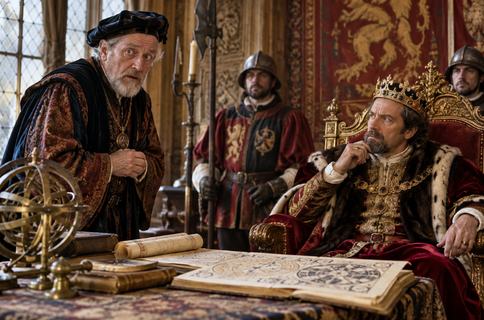
A king’s astrologer requested an urgent audience with His Majesty.
“Your Majesty, I have some very distressing news. I predict that you will be dead within seven days.”
The king considered this for a moment.
“That is distressing news indeed. And when, pray tell, do you predict you will die?”
“Oh,” replied the astrologer confidently. “I shan’t die for another thirty years.”
The king had him executed immediately.
It made me laugh when I first read it. It made Jonathan laugh when I reminded him of it.
But beneath the joke is one of the most serious questions astrology can confront.
Some predictions can’t be taken back
An astrologer can tell somebody that an awkward period at work should improve. They can suggest that a relationship is entering an important phase. They can identify periods associated with pressure, endings, beginnings, upheaval or opportunity.
Predict somebody’s death, however, and something fundamentally changes.
You haven’t simply given them information. You may have changed every day they have left.
Even if the prediction is completely wrong, its consequences can be horribly real. Every illness could become evidence. Every approaching date could become frightening. Decisions about relationships, money, family and the future might all be influenced by something an astrologer had no business presenting as certainty in the first place.
And this is where a very old astrological question suddenly becomes a very modern technological one.
What happens when the astrologer is an algorithm?
For centuries, astrological prediction ultimately passed through a human being.
Whatever techniques an astrologer used, somebody had to interpret them and decide what to tell the client. That created something no astronomical table or calculation could provide: judgment.
Today, astrology can operate very differently.
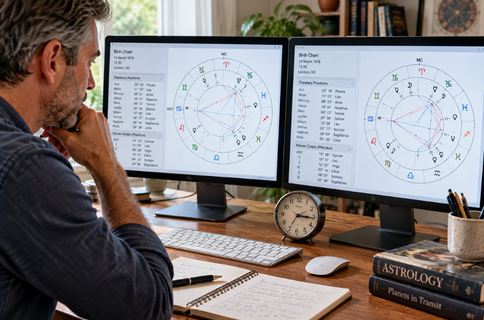
Software can calculate thousands of astrological factors almost instantaneously. AI can analyze combinations of data and turn them into fluent, convincing language. Systems can produce interpretations without an astrologer ever meeting—or even knowing—the person receiving them.
That capability is extraordinary.
It also creates responsibility.
Suppose somebody asks an AI-powered astrology service: “When will I die?”
Should it answer?
And if it shouldn’t, who decides where that boundary lies?
“A prediction of death doesn’t simply give someone information. It may change every day they have left.”
Precision isn’t the same as certainty
Technology has made astrological calculation astonishingly precise. Modern software can establish planetary positions for a particular moment without an astrologer spending hours working through tables and logarithms. But there’s a dangerous psychological leap from precise calculation to precise interpretation. A computer may calculate exactly where Saturn will be at 10:37 a.m. on a particular Tuesday. That doesn’t mean it can therefore calculate exactly what will happen to you at 10:37 a.m.
Those are two very different propositions.
This distinction becomes especially important when AI is involved because computers can sound extraordinarily confident. A beautifully written answer, delivered instantly and containing impressive-looking technical detail, can acquire an authority it doesn’t necessarily deserve.
When the subject is somebody’s death, that isn’t merely an accuracy problem. It’s an ethical one.
Sometimes the best technology should refuse
We’re accustomed to judging technology by what it allows us to do.
Faster calculations. More personalization. Better automation. More sophisticated analysis.
Perhaps we should occasionally judge it by what it refuses to do.
A well-designed astrology platform doesn’t become inferior because there are questions it won’t answer. In some circumstances, refusing to generate a prediction may demonstrate greater sophistication than generating one.
That’s particularly relevant as astrology becomes increasingly automated. The ethical standards that once existed inside an astrologer’s head increasingly need to exist inside the technology too.
And those decisions cannot simply be delegated to an algorithm. Human beings have to decide what their technology should and shouldn’t do.
The astrologer still matters
Jonathan Cainer died in 2016. Afterward, his spokeswoman addressed the inevitable question of whether an astrologer of his stature should have foreseen his own death.
She explained that Jonathan had always been adamant that astrologers shouldn’t attempt to predict when somebody would die, citing, among other concerns, the possibility of creating a self-fulfilling prophecy. The Guardian
That makes the little story I remembered from his Today days rather more poignant now.
I still believe what I believed when Jonathan and I discussed it.
There are boundaries an astrologer shouldn’t cross.
Technology can calculate things that would once have taken an astrologer hours. AI can identify patterns, process enormous quantities of information and communicate its conclusions almost instantly.
But the most important question isn’t always “Can we?”
Sometimes it’s “Should we?”
And perhaps the king’s astrologer discovered that distinction just a little too late.
Thank you for reading.
Jeff Prince
Astrologer & Development Manager, Horoscope Services
About the author
Jeff Prince has spent more than 25 years helping to develop astrology software, horoscope APIs, white-label astrology platforms and globally syndicated horoscope content.
Through his Prinsights blog, he continues to explore the synergies between astrology, artificial intelligence and technology.
Enjoy Prinsights? Add Horoscope Services as a Preferred Source on Google.