Imagine visiting your doctor with a painful knee, only to be told that treatment should wait until the Moon moves into a more favorable zodiac sign.
Today, you’d probably question the doctor’s qualifications. Five hundred years ago, however, you might have considered such advice perfectly reasonable.
For centuries, medical astrology was part of mainstream European medicine. Physicians studied planetary movements, consulted astrological charts and considered the Moon’s position before recommending certain treatments. Astrology wasn’t necessarily regarded as an alternative to medicine. It was woven into how medicine itself was understood.
So why did educated physicians believe the heavens could influence human health? And what changed?
When Medical Astrology Was Part of Mainstream Medicine
It’s tempting to imagine historical physicians as superstitious people who knew little about the human body. But that overlooks how sophisticated some medical traditions were within the knowledge available at the time.
In medieval and Renaissance Europe, medicine drew heavily on ancient Greek authorities, particularly Hippocrates and Galen. Health was commonly understood through the theory of four bodily humors: blood, phlegm, yellow bile and black bile.
These were associated with qualities such as heat, coldness, moisture and dryness. Illness was often interpreted as an imbalance that treatment should correct.
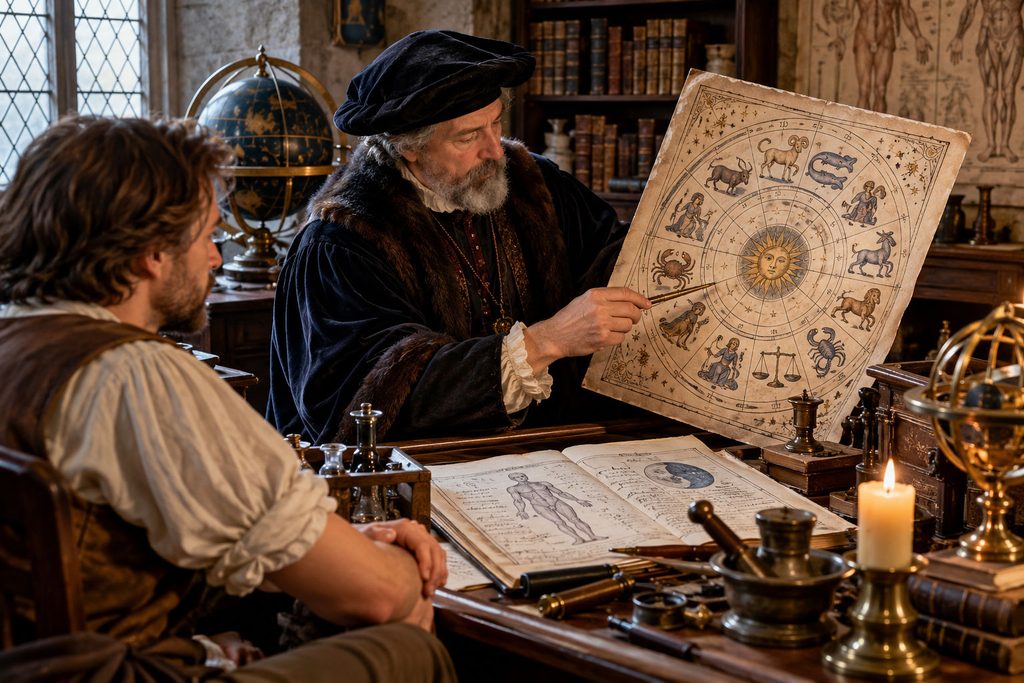
Astrology appeared to fit neatly into this system.
The Sun, Moon and planets were believed to influence conditions on Earth, including the human body. If the Moon could visibly influence tides, it seemed reasonable to some physicians that celestial movements might also influence a person’s bodily fluids and health.
That comparison wasn’t scientific proof, of course. But within the intellectual framework of the period, it offered an apparently coherent explanation.
Astrology also provided something physicians desperately needed: a method of choosing when to act.
A treatment might be considered appropriate in principle but poorly timed according to the heavens.
And that brings us to one of medical astrology’s strangest surviving images.
The Zodiac Man: When Your Body Had Its Own Horoscope
One of the most recognizable images in historical medical astrology is the Zodiac Man, sometimes called Homo Signorum, or the Man of Signs.
Picture a human figure surrounded by the twelve zodiac signs, each associated with a particular part of the body.
Aries governed the head. Taurus ruled the neck and throat. Gemini was linked with the arms and shoulders. Cancer corresponded to the chest, Leo to the heart, and Virgo to the abdomen.
The associations continued down the body until Pisces reached the feet.
“For centuries, doctors didn’t consult the stars instead of practicing medicine. They believed consulting the stars was part of practicing medicine.”
This wasn’t merely decorative artwork. It served as a reference for practitioners deciding when certain treatments should take place.
A physician considering bloodletting, for example, might consult the Moon’s zodiac position before proceeding. In some traditions, treating a body part while the Moon occupied its corresponding sign was discouraged.
The reasoning reflected a belief that the body’s vulnerability changed according to celestial timing.
Yale University Library’s exhibition on the Zodiac Man and astrological anatomy documents how these illustrations appeared in medical manuscripts, almanacs and printed publications.
What makes the Zodiac Man especially fascinating is how widely such imagery circulated. Astrology wasn’t confined to an eccentric physician’s private study. It appeared in practical reference materials that people could consult.
A medieval medical almanac could resemble a curious mixture of calendar, anatomical chart and horoscope.
Imagine trying to explain that to somebody sitting in a modern hospital waiting room.
Bloodletting, Planetary Timing and the Moon
Bloodletting was one of the most familiar medical treatments in medieval and early modern Europe.
Physicians believed that removing blood could help restore bodily balance. The practice was used for an astonishing variety of complaints, although we now know it was frequently ineffective and sometimes dangerous.
Medical astrology added another consideration: the timing of the procedure.
The Moon was particularly important because it moved relatively quickly through the zodiac, offering a changing calendar of supposedly favorable and unfavorable days.
Other planetary configurations could also influence a practitioner’s judgment.
This didn’t mean every physician followed identical rules. Medical traditions differed across regions and periods, and practitioners varied in how heavily they relied on astrology.
Nevertheless, the underlying principle was remarkably persistent.
A treatment wasn’t simply a question of what should be done. It could also depend on when the heavens suggested it should be done.
There’s an important distinction here. Modern medicine does recognize that timing can matter. Circadian rhythms, medication schedules and the progression of disease can all influence treatment.
But those relationships are investigated through physiological mechanisms and clinical evidence.
The historical belief that zodiac positions determined safe treatment dates was something quite different.
The Astrologer-Doctors Who Recorded 80,000 Consultations
If medical astrology sounds like an obscure medieval curiosity, the surviving records of two English practitioners tell a different story.
Simon Forman (1552–1611) and Richard Napier (1559–1634) practiced astrological medicine in England around the turn of the seventeenth century.
Forman was a controversial London practitioner whose clashes with the medical establishment were almost as colorful as his personal life.
Napier, a Buckinghamshire clergyman, became his student and developed a substantial practice of his own.
Together, they left an extraordinary historical record.
Researchers at the University of Cambridge have studied and digitized approximately 80,000 consultations recorded between 1596 and 1634.
Their patients came from different social backgrounds and brought an astonishing range of concerns.
They worried about illness, pregnancy, fertility, emotional distress and unexplained symptoms. Some also sought answers about missing possessions, relationships or suspected witchcraft.
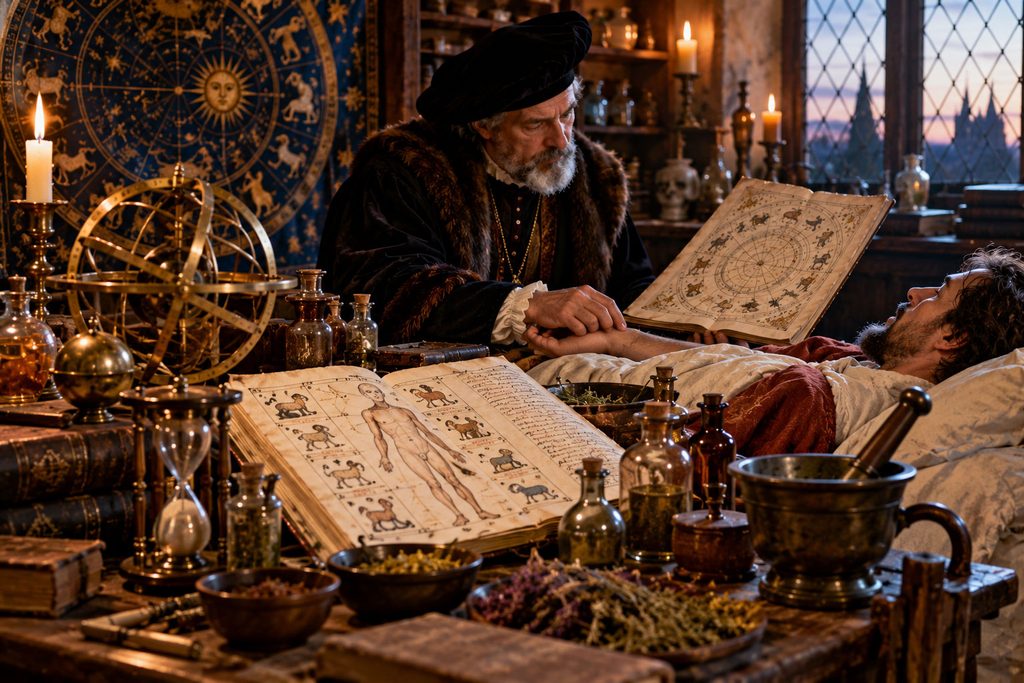
Forman and Napier commonly used horary astrology: constructing a chart for the moment a question was asked, rather than relying on the patient’s birth chart.
The chart was then interpreted to investigate the problem and its possible outcome.
These were not casual scribblings. The surviving casebooks preserve names, questions, dates, astrological calculations and, in many instances, recommended treatments. The University of Cambridge’s Casebooks Project allows modern readers to explore these remarkable records.
What emerges is more than a history of astrology.
It’s a record of ordinary people confronting frightening uncertainties with the knowledge and resources available to them.
Some were desperately ill. Others were worried about loved ones. Many simply wanted reassurance that somebody understood what was happening.
Four centuries later, that human need is immediately recognizable.
Why Did Educated People Believe It Worked?
Here’s an uncomfortable question.
If medical astrology was so widespread, does that mean generations of intelligent physicians were simply foolish?
Not necessarily.
People interpret evidence through the intellectual frameworks available to them.
Before modern microbiology, controlled clinical trials and sophisticated diagnostic technology, physicians lacked explanations for many diseases.
Astrology offered a structured system that appeared to connect observations about the natural world with patterns of illness and recovery.
It also carried considerable intellectual prestige.
For much of medieval European history, astronomy and astrology were closely connected. Calculating planetary positions required mathematical knowledge, and astrological ideas were taught in university settings.
A physician who consulted an astronomical table wasn’t necessarily rejecting the medicine of the period. He might believe he was applying it more thoroughly.
Of course, a system can be mathematically sophisticated without its medical claims being correct.
Calculating the Moon’s position accurately doesn’t establish that its zodiac sign influences the safety of bloodletting.
That’s a distinction worth remembering whenever impressive calculations are presented as evidence of a much broader claim.
Why Did Astrology Disappear From Mainstream Medicine?
Medical astrology didn’t vanish overnight.
Its influence weakened gradually as European medicine changed.
From the sixteenth century onward, anatomical investigation increasingly challenged inherited assumptions about the human body. Andreas Vesalius, whose influential anatomical work appeared in 1543, helped establish a more observational approach to anatomy.
Over subsequent centuries, advances in physiology, pathology, microbiology and experimental medicine transformed how illness was understood.
Physicians developed increasingly effective ways to investigate what was happening inside the body.
The authority of ancient medical theories declined, including the humoral framework that had accommodated so much astrological thinking.
Medical astrology also faced a more fundamental problem.
Its claims about planetary influences on disease and treatment did not acquire the reliable clinical evidence needed to justify their continued use.
Today, astrology is not an evidence-based method for diagnosing disease, choosing medication or determining when surgery should occur.
That doesn’t make its historical significance disappear.
It means we can study why people believed in medical astrology without accepting its medical conclusions.
And understanding that difference is essential to understanding the history of science itself.
What Medical Astrology Reveals About the History of Science
There’s a wider lesson in this story.
We often imagine scientific progress as a straightforward journey from ignorance to knowledge, with sensible people steadily replacing foolish ideas.
History is rarely that tidy.
Medical astrology flourished because it fitted into an established understanding of nature. It offered explanations, organizing principles and a sense of control over frightening uncertainties.
Its history also connects with a question explored in Prinsights: who invented astrology, and why did anyone believe it?
Astrology didn’t develop in isolation from intellectual life. It grew alongside attempts to understand mathematics, astronomy, philosophy and medicine.
And the desire for precise answers hasn’t disappeared.
In another Prinsights article, we examined why an accurate birth time matters when calculating a horoscope. Modern astrological software can produce impressively precise calculations, but precision alone doesn’t establish the validity of an interpretation.
The physicians of five hundred years ago faced a comparable distinction, even if they didn’t recognize it.
They could calculate celestial positions accurately while drawing medical conclusions that were mistaken.
Perhaps that’s the most interesting thing about medical astrology.
It reminds us that intelligence, education and mathematical sophistication don’t make anyone immune to accepting an incorrect explanation.
And that includes us.
The next time you visit your doctor, be grateful that medical decisions no longer depend on whether Mars is behaving itself or the Moon has wandered into Taurus.
But spare a thought for the physicians who genuinely believed they were doing their best by consulting the stars.
They weren’t necessarily choosing astrology instead of medicine.
For a significant period of history, they believed astrology was part of medicine.
And that makes the story considerably more fascinating than simply dismissing it as superstition.
Thank you for reading.
Jeff Prince
Astrologer & Development Manager, Horoscope Services

About the author
Jeff Prince has spent more than 25 years helping to develop astrology software, horoscope APIs, white-label astrology platforms and globally syndicated horoscope content.
Through his Prinsights blog, he continues to explore the synergies between astrology, artificial intelligence and technology.
Enjoy Prinsights? Add Horoscope Services as a Preferred Source on Google.