Could one of the most famous stories in Christianity also be a story about astrology?
Every Christmas, we see familiar images of three elaborately dressed men traveling across a desert, following a spectacularly bright star. They’re carrying gifts, riding camels and heading toward Bethlehem.
It’s a scene so deeply embedded in Western culture that few people question the details.
But were the Three Wise Men astrologers? Were there actually three of them? Were they kings? And was the celestial phenomenon that prompted their journey even a star?
The answers might surprise you. Particularly if you’ve spent your life assuming that astrology and Christianity have always occupied opposite sides of a theological fence.
Were the Three Wise Men Astrologers or Kings?
Let’s begin by separating the biblical account from the Christmas card version. (And I’ll refrain from mentioning the opening scene of Monty Python’s film “The Life of Brian“, too!)
The story appears in the Gospel of Matthew. Of the four canonical Gospels, Matthew alone describes the visit of the Magi and the Star of Bethlehem.
Nowhere does Matthew specify that there were three visitors. Nor does he identify them as kings, provide their names or mention camels.
The assumption that there were three probably originated from the three gifts they presented: gold, frankincense and myrrh.
The word Matthew uses is the Greek magoi, from which we get the English word Magi. Historically, the term was associated with a Persian priestly caste, although its meaning subsequently broadened to encompass people with expertise in divination and celestial interpretation.
Interestingly, the biblical commentary accompanying Chapter 2 of the Gospel of Matthew, published by the United States Conference of Catholic Bishops, explicitly identifies Matthew’s Magi as astrologers. USCCB
That’s not a modern astrologer attempting to claim historical territory. That’s an interpretation published by an official Catholic organization.
Why Would Astrologers Be Interested in the Birth of a King?
Were the three wise men astrologers? Well, to understand their possible motivation, we need to abandon our modern distinction between astronomy and astrology.
Two thousand years ago, observing the heavens and interpreting their movements were closely related activities. Celestial events were frequently regarded as significant indicators of earthly developments, particularly those involving rulers, kingdoms and political upheaval.
As we explored in Who Invented Astrology — and Why Did Anyone Believe It?, much of ancient astrology concerned the fortunes of entire civilizations rather than the personal lives of individuals.
The appearance of an unusual celestial configuration might therefore have been interpreted as the announcement of a new ruler.
“Observing a celestial phenomenon is astronomy. Attributing earthly significance to it is astrology.”
The significant detail in Matthew’s account is that the Magi didn’t merely notice something unusual in the sky. They associated it with the birth of a particular king.
Observing a celestial phenomenon is astronomy. Attributing earthly significance to it is astrology.
Whatever Matthew intended his readers to understand, the Magi’s behavior fits remarkably well with ancient astrological practice.
Was the Star of Bethlehem Actually a Planetary Conjunction?
If the Star of Bethlehem was a real astronomical phenomenon, what might it have been?
Several possibilities have been proposed over the centuries, including comets, exploding stars and planetary conjunctions.
One particularly interesting candidate is a series of three conjunctions between Jupiter and Saturn in 7 BC.
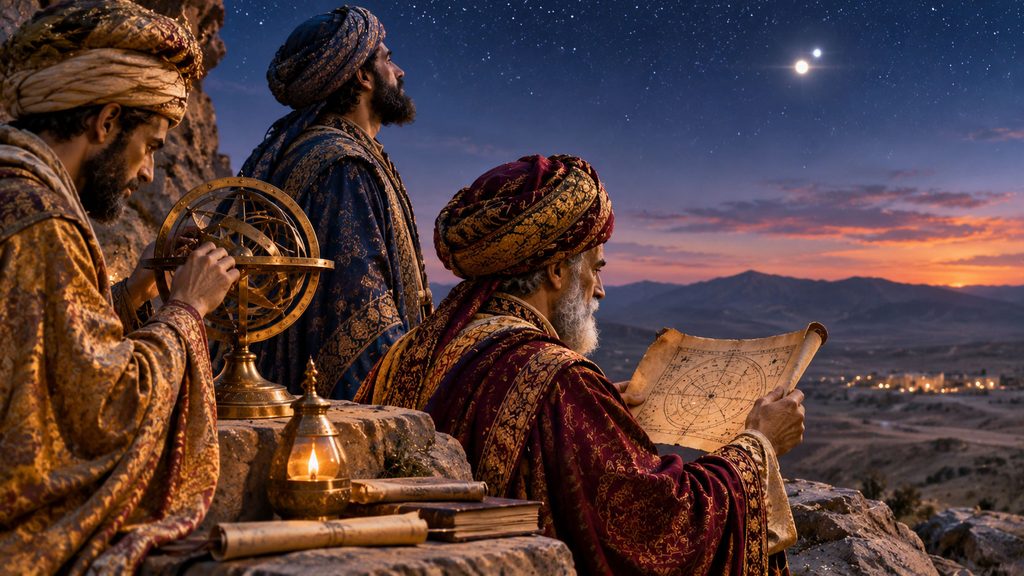
During that year, the two planets appeared to approach each other three times in the region of Pisces. This occurred because of the apparent backward movement of planets as viewed from Earth, known as retrograde motion.
Jupiter and Saturn come into conjunction approximately every twenty years. However, a triple conjunction is considerably less common. For ancient astrologers, such an event could have carried considerable symbolic weight.
Jupiter had longstanding associations with kingship, while the significance attributed to Saturn varied according to the astrological tradition.
However, there’s an important distinction. During these conjunctions, Jupiter and Saturn did not appear to merge into a single brilliant object.
The event’s significance might therefore have been more astrological than spectacularly astronomical.
What If the Star Wasn’t Particularly Bright?
This is where the story becomes even more interesting.
Matthew doesn’t describe an exceptionally bright star illuminating the night sky. Neither does he suggest that crowds of people were astonished by its appearance.
Perhaps what mattered was not how the celestial phenomenon looked, but what the Magi understood it to represent.
Other proposed explanations involve Jupiter’s apparent stationary movement, encounters between Jupiter and Venus, and configurations involving Regulus, a prominent star traditionally associated with royalty.
Royal Museums Greenwich examines several astronomical explanations for the Star of Bethlehem, illustrating how different celestial events might have inspired the account. Royal Museums Greenwich
As we discussed in Why Are There Twelve Zodiac Signs? Who Decided?, ancient observers had developed sophisticated systems for tracking planetary movements long before the traditional date of Christ’s birth.
The Magi, as portrayed in Matthew, may have recognized something that an ordinary observer would have considered unremarkable.
Think of a chess expert watching a game. What appears to a casual spectator to be an insignificant movement of a piece might reveal an elaborate strategy to someone who understands the game.
Can Astronomy Establish When Jesus Was Born?
You might reasonably wonder why astronomers are investigating celestial events in 7 BC when Jesus was supposedly born at the beginning of the Christian calendar.
The explanation is that the calendar system numbering years in relation to Christ’s birth was developed centuries later. Its calculation was imperfect.
Matthew places Jesus’s birth during the reign of Herod the Great, whose death is conventionally dated to 4 BC, although alternative chronologies have been proposed.
This makes celestial events occurring several years before AD 1 worthy of investigation.
There is also no biblical confirmation that Jesus was born on December 25.
Unfortunately, identifying an impressive planetary configuration within a plausible historical period doesn’t establish that it was the Star of Bethlehem. Nor does it establish Jesus’s precise birth date.
Astronomy can reconstruct the ancient sky with remarkable accuracy. It cannot independently establish how particular people interpreted what they saw — or whether the events described in Matthew happened as narrated.
Christianity’s Complicated Relationship With Astrology
Throughout Christian history, attitudes toward astrology have been complicated.
Religious objections have frequently centered on the idea that celestial bodies determine human destiny, potentially undermining divine authority and individual free will.
Yet Matthew presents the Magi positively. Their celestial knowledge forms part of a narrative that leads them toward Jesus rather than away from him.
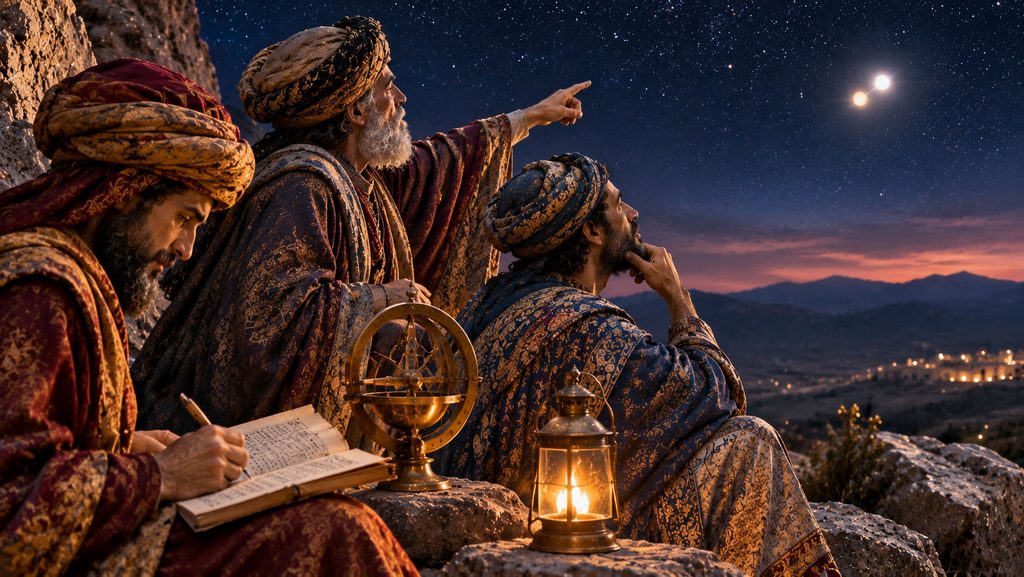
Christian interpretations differ regarding what this means. Some understand the star as a miraculous expression of divine guidance. Others regard the story as proof that people outside the Jewish religious tradition were also drawn toward Christ.
Recognizing an astrological element in the story doesn’t mean Christianity endorses astrology. Nor does it provide scientific evidence that astrological predictions are reliable.
Nevertheless, it makes the relationship between these two ancient traditions considerably more interesting than it might initially appear.
What Were the Wise Men Really Following?
More than two thousand years later, we still cannot establish the precise nature of the Star of Bethlehem.
Whether the three wise men were astrologers, astronomers, or both, they certainly identified a conjunction, comet or another phenomenon as a miraculous sign or a literary and theological symbol.
But were the Three Wise Men astrologers?
Within the historical and linguistic context of Matthew’s account, that is a credible and well-established interpretation of who the Magi were supposed to be.
Perhaps the most intriguing possibility is that they weren’t following a spectacular light across the desert like an ancient celestial navigation system.
They were following what they believed the heavens were telling them.
And if that interpretation is correct, then every Christmas, millions of people unknowingly retell a story in which astrology plays a rather important role.
Thank you for reading.

Jeff Prince
Astrologer & Development Manager, Horoscope Services

About the author
Jeff Prince has spent more than 25 years helping to develop astrology software, horoscope APIs, white-label astrology platforms and globally syndicated horoscope content.
Through his Prinsights blog, he continues to explore the synergies between astrology, artificial intelligence and technology.
Enjoy Prinsights? Add Horoscope Services as a Preferred Source on Google.