You might be an Aries, a Taurus or a Sagittarius. But have you ever wondered who decided there should be twelve zodiac signs in the first place?
Why are there 12 zodiac signs? Why not ten, thirteen or twenty-four? And why does every sign occupy exactly 30 degrees of the zodiac when the constellations they’re named after are different sizes?
The answers take us back more than 2,000 years, to ancient Babylon, where astronomers were developing sophisticated methods of tracking the heavens.
What emerged wasn’t simply a collection of twelve personality types. It was a mathematical system that would eventually influence Greek astronomy, Western astrology and the horoscope you might read on your phone this morning.
And nobody appears to have called a meeting to decide that twelve was the magic number.
Why Are There 12 Zodiac Signs Instead of Another Number?
The number twelve wasn’t plucked out of thin air.
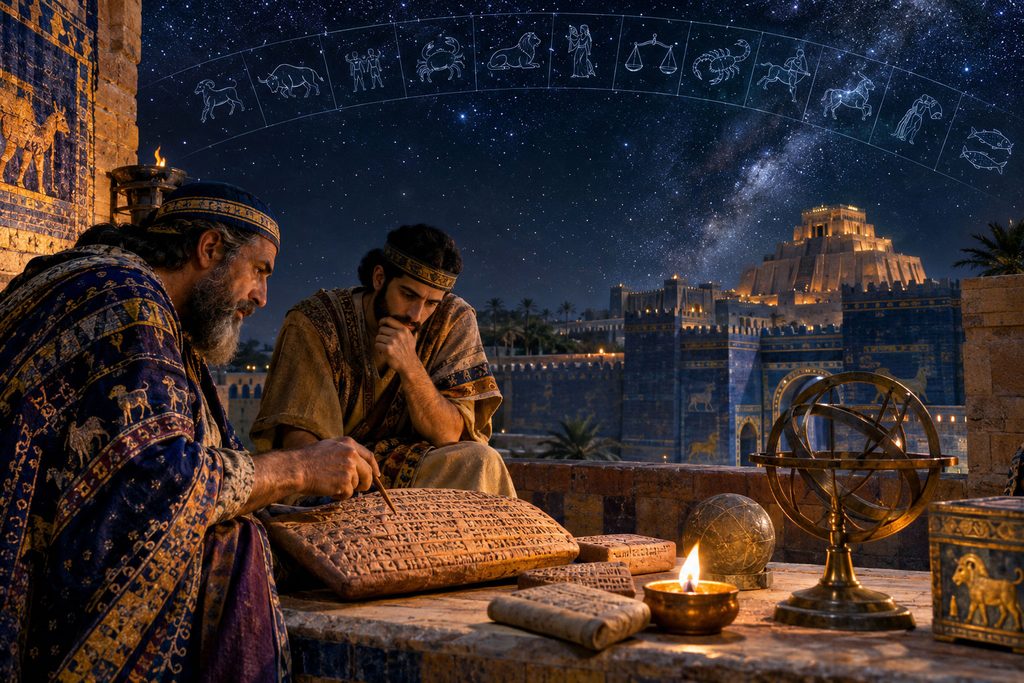
Ancient civilizations noticed that roughly twelve lunar cycles occurred during a solar year. The Babylonians also used calendars with twelve months, adding an extra month when necessary to keep the calendar aligned with the seasons.
Their mathematical traditions made twelve particularly convenient. Babylonian calculations used a sexagesimal, or base-60, system. Sixty divides neatly by twelve, and twelve itself can be divided by two, three, four and six. Try dividing a circle into eleven equal sections without a calculator. You’ll soon appreciate the appeal of twelve.
But the connection between the calendar and the zodiac is more interesting than a simple preference for convenient numbers.
Babylonian astronomy employed an idealized year of twelve 30-day months, giving 360 days. Dividing the Sun’s apparent annual path into twelve sections of 30 degrees created a similarly orderly framework.
The actual solar year is approximately 365.24 days, of course. The Babylonians were capable of recognizing that discrepancy. Their schematic calendar wasn’t necessarily intended as a literal description of the year’s length.
It was a useful mathematical model.
“The twelve zodiac signs weren’t simply invented to describe personalities. They began as a remarkably practical way of measuring the sky.”
And that distinction matters. The zodiac was becoming a way to measure celestial positions, not merely a collection of pictures imagined among the stars.
Who Invented the Twelve Zodiac Signs?
If we’re looking for the civilization most responsible for the familiar twelve-sign zodiac, the Babylonians deserve considerable credit.
But identifying a single inventor is another matter.
Mesopotamian astronomers had been observing celestial movements for centuries before the standardized zodiac appeared. Earlier traditions identified numerous constellations along the paths followed by the Moon and planets.
Some systems recognized seventeen or eighteen constellations in this region of the sky. The arrangement was considerably less tidy than today’s twelve-sign zodiac.
During the fifth century BCE, Babylonian astronomers developed a more systematic approach. By approximately 400 BCE, the zodiac had emerged as twelve equal sections of 30 degrees.
Research into the development of Babylonian planetary astronomy shows how this mathematical framework made it possible to describe celestial positions with much greater consistency.
Instead of saying a planet was somewhere near a particular star, astronomers could specify its position within a zodiac sign using degrees.
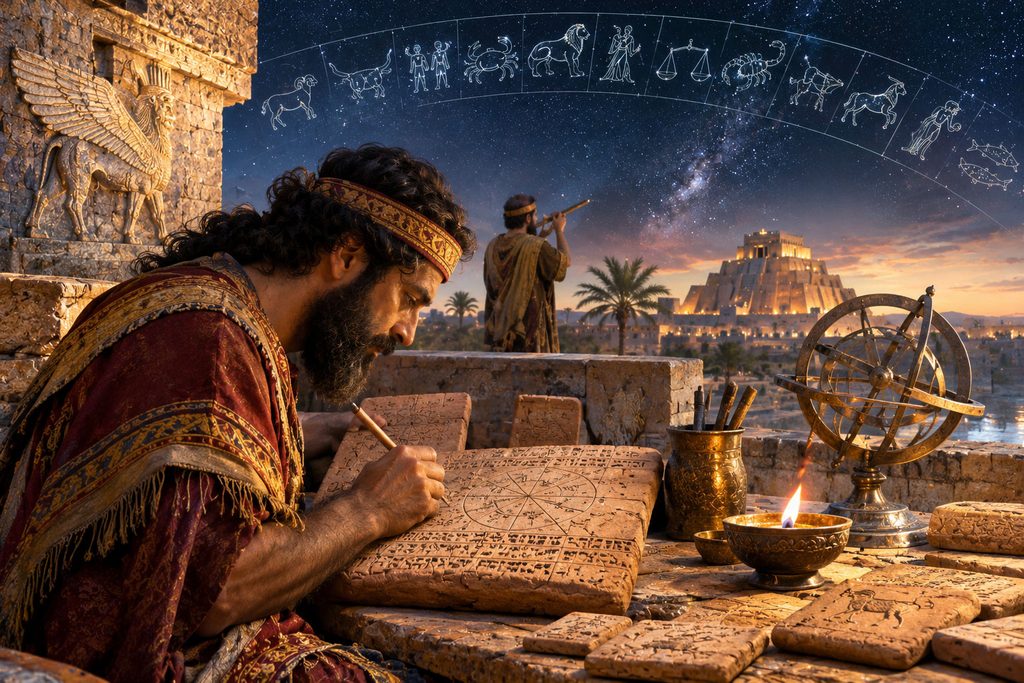
It was rather like replacing directions based on landmarks with a standardized coordinate system.
The names of the twelve signs drew upon existing constellations and earlier celestial traditions. The system evolved over generations rather than appearing as one person’s brilliant invention. We’ve previously explored the wider historical question in Who Invented Astrology — and Why Did Anyone Believe It?. The important distinction is that astrology existed long before the twelve equal zodiac signs became standard.
Why Does Every Zodiac Sign Have Exactly 30 Degrees?
Here’s something that surprises many people: the zodiac signs are equal in size, but the constellations aren’t.
Virgo occupies a much larger region of the sky than Aries. Other constellations vary considerably in shape and extent.
Yet in the zodiac used by astrologers, Aries always occupies 30 degrees. So does Taurus, Gemini and every other sign.
That’s because a zodiac sign is a section of a celestial coordinate system, not the physical outline of a constellation.
Imagine dividing a clock face into twelve equal portions. The numbers provide a convenient way to describe positions, regardless of what happens to be visible behind the clock.
The zodiac works in a comparable way.
Its twelve divisions follow the ecliptic, the apparent annual path of the Sun against the background stars, as viewed from Earth.
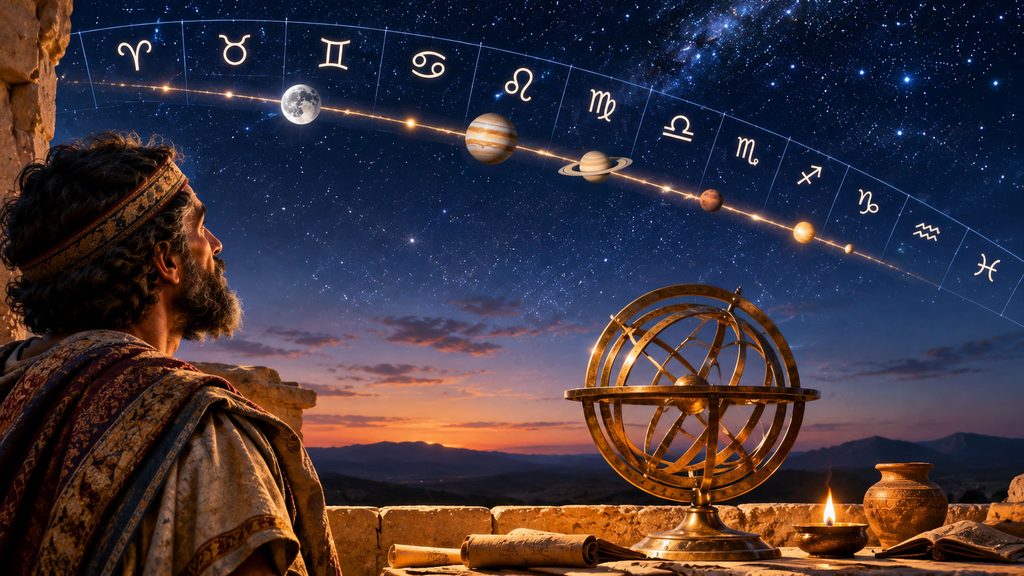
The Moon and planets generally appear near this path because the major bodies of our solar system orbit in approximately the same plane.
Once astronomers established twelve equal divisions, they had a system for tracking movement. This explains why someone can have several planets in the same zodiac sign without them appearing close together in physical space. Astrological positions describe directions from Earth, not distances between celestial bodies.
Why Does the Zodiac Begin With Aries?
If the zodiac is a circle, why does Aries get first place?
Why not Capricorn, which is associated with the beginning of our calendar year? Or Leo, which would presumably enjoy being first?
The answer involves the relationship between the zodiac, the seasons and the spring equinox.
In the tropical zodiac used by most Western astrologers, Aries begins at the March equinox, when the Sun crosses the celestial equator moving northward.
That point is defined as zero degrees Aries.
The tropical zodiac therefore remains connected to the seasonal cycle rather than being fixed to the background constellations.
Historically, the situation was more complicated. The Babylonian zodiac was associated with the stars, while later Greek astronomical and astrological traditions developed the seasonal framework familiar to Western astrology.
This distinction becomes particularly important when people claim that everyone’s zodiac sign has changed.
Have the Zodiac Signs Moved Since Ancient Times?
Yes and no. It depends on which zodiac we’re discussing.
Earth’s rotational axis slowly changes direction in a motion called precession. One complete cycle takes approximately 26,000 years.
Consequently, the equinox points gradually shift relative to the background stars.
Over many centuries, this creates a noticeable difference between the positions of the tropical zodiac signs and the constellations sharing their names.
In tropical astrology, zero degrees Aries remains tied to the March equinox.
In sidereal systems, zodiac positions are defined in relation to the stars, although different sidereal traditions use somewhat different reference points.
Neither system requires the constellations themselves to occupy equal sections of the sky.
The confusion arises when someone assumes that a zodiac sign and its namesake constellation must be exactly the same thing.
They aren’t.
This is also why accurate birth information matters when calculating an individual horoscope. As we explain in Your Birth Time Matters More Than Ever — What If It’s Wrong?, even a relatively small timing error can affect important chart details, particularly the Ascendant and house positions.
What About Ophiuchus, the Supposed Thirteenth Zodiac Sign?
Every so often, headlines announce that astronomers have discovered a thirteenth zodiac sign and that millions of people have been reading the wrong horoscope.
The constellation usually responsible for the excitement is Ophiuchus, the Serpent Bearer.
Ophiuchus isn’t a new discovery. It has been recognized since antiquity, and part of the constellation lies along the Sun’s apparent path.
So why isn’t it included among the traditional twelve signs?
Because the zodiac wasn’t designed as a modern catalog of every constellation crossed by the ecliptic.
The twelve signs are equal mathematical divisions. Ophiuchus is a constellation with boundaries established under modern astronomical conventions.
These are different ways of organizing the sky.
Astronomers can correctly state that the Sun passes through Ophiuchus without demonstrating that traditional astrology must introduce a thirteenth equal zodiac sign.
Likewise, astrologers cannot reasonably claim that Ophiuchus doesn’t exist simply because their system uses twelve divisions.
Both statements can be true without contradiction.
The historical development of these different systems is examined in the scholarly Encyclopaedia Iranica’s history of the zodiac, which traces the transition from earlier Mesopotamian constellations to the standardized twelve-sign framework.
Did the Greeks Invent the Zodiac We Use Today?
The Greeks didn’t invent the underlying twelve-sign system, but they played an enormous role in developing the astrology that eventually became familiar throughout the Western world.
Following the spread of Babylonian astronomical knowledge into the Greek-speaking world, scholars combined mathematical techniques with philosophical ideas about the cosmos.
Over time, Hellenistic astrologers developed increasingly elaborate systems involving planetary rulerships, houses, aspects and interpretations of individual birth charts.
The zodiac became more than a celestial measuring instrument.
It became part of a symbolic language through which astrologers attempted to interpret character, circumstances and human experience.
That doesn’t mean the symbolic interpretations have been scientifically established. The historical sophistication of a system and the scientific validity of its claims are separate questions.
Nevertheless, understanding how the zodiac developed makes it difficult to dismiss the entire tradition as a collection of arbitrary star signs invented for newspaper entertainment.
Its origins are considerably older, and its mathematical foundations are much more substantial.
Why Do We Still Have Twelve Zodiac Signs Today?
So, why ARE there 12 zodiac signs?
Because ancient astronomers developed a practical method of dividing the Sun’s apparent path into twelve equal sections, building upon earlier constellations, calendar traditions and mathematical techniques.
The Babylonians were central to that development. Greek astronomers and astrologers subsequently adapted and expanded the system, helping establish traditions that survived for more than two millennia.
The number twelve wasn’t inevitable. Other divisions of the sky were possible, and earlier systems demonstrate that different arrangements existed.
But twelve proved useful, understandable and remarkably durable.
Perhaps the most surprising thing about the zodiac isn’t that people still associate Aries with courage or Libra with relationships.
It’s that a mathematical framework developed by ancient astronomers remains recognizable whenever someone asks, “What’s your star sign?”
They probably didn’t anticipate that their work would eventually become a topic of conversation on dating apps.
Then again, predicting the future was rather their line of business.
Thank you for reading.

Jeff Prince
Astrologer & Development Manager, Horoscope Services

About the author
Jeff Prince has spent more than 25 years helping to develop astrology software, horoscope APIs, white-label astrology platforms and globally syndicated horoscope content.
Through his Prinsights blog, he continues to explore the synergies between astrology, artificial intelligence and technology.
Enjoy Prinsights? Add Horoscope Services as a Preferred Source on Google.